Guanacos

First Nahuat dictionary in El Salvador

El Salvador will have the first Nahuat dictionary. A creation made with the help of Nantzin Sixta Pérez, 81, a Salvadoran woman native speaker of the language in the country. This book will contribute and be part of the efforts made to maintain and revitalize Nahuat, an indigenous language still spoken in the country.

A donation campaign was launched for the printing of the first copies of this dictionary thanks to the support of an international organization.

The publishing of the first Nahuat dictionary in the country

First- Nahuat Dictionary - Héctor Josué Martínez Flores Nahuat teacher in El Salvador.
Héctor Josué Martínez Flores with two of the “nahua speakers” involved with the project. Courtesy photography.

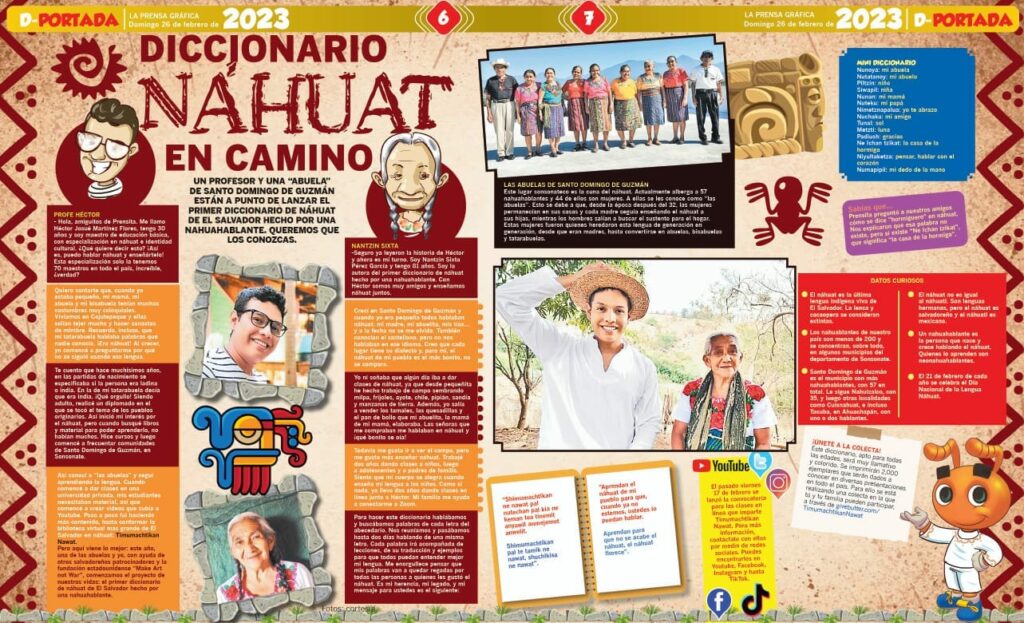
The creation of the first Nahuat dictionary is led by Héctor Josué Martínez Flores, a teacher who specializes in Nahuat. He is also the founder of Timumachtikan Nawat (Let’s learn Nahuat).

This project promotes the popularization of Nahuat, in addition to the teaching of the language through its school program “Ne Ichan Safoura”.

Regarding the dictionary, Héctor Martínez, explains that the idea was born from the need to create a book of a “Nahua speaker” that would document, with the help of Nantzin Sixta Pérez, the language, the worldview, in addition to the oral tradition of the language.

Every February 21, the National Day of the Nahuat Language is celebrated in El Salvador. Video courtesy of: Ministerio de Educación.

Another reason is the little bibliographic documentation of Nahuat that exists in El Salvador. Not to mention that it has been done mostly by foreign authors, so it does not recognize the different dialects of the language.

“No one is paying attention to dialectal variants, and in El Salvador, when we talk about Nahuat, we must recognize that there are dialectal variants just as there are in Spanish… The Nahuat of Santo Domingo de Guzmán is different from the Nahuat of Nahuizalco, Cuisnahuat, Tacuba…”, said Héctor Martínez.

Documentary referring to the Nahuat language in the country. Video courtesy of: Cuna Nahuat.

Dictionary Structure

Infographic regarding the publication of the first Nahuat dictionary in El Salvador.
Infographic regarding the publication of the dictionary. Image courtesy.

The dialect variant on which the dictionary will focus will be in the municipality of Santo Domingo de Guzmán, department of Sonsonate. This is because it is the largest language enclave in the country, with 57 Nahua speakers according to December 2022 data.

“With the dictionary, we are sure that Nahuat will be documented, practically most of the language will be captured and people will be sure that all the information there is correct because it has been said by a native speaker,” explained Héctor Martínez.

“Along with the word in Nahuat, its meaning, and its grammatical category, which means that we are going to explain if it is a verb, adjective, noun, determinative… We’re also going to add sentences so people know how to use that word,” asserted the teacher.

He also explained that on top of that, the dictionary will document topics such as number counting and Nahuat arithmetic.

Conversation about the importance of the Nahuat language in El Salvador. Video courtesy of:  Radio YSUCA.

Project execution

Héctor Josué Martínez Flores with "Nahua Speakers" participants of the project of the first Nahuat dictionary.
Héctor Josué Martínez Flores with “Nahua Speakers” participants of the project. Courtesy photography.

To carry out the project of creating the dictionary, they have the support of the American foundation Make Art Not War, with which they have started a donation campaign for the printing of the first two thousand copies. Moreover, with the proceeds, they seek to pay the team’s fees and the expenses of publishing the book. 

You can support the donation campaign by going to the following link.

Information about the Timumachtikan Nawat project. Courtesy video.

Nantzin Sixta Pérez, author of first Nahuat dictionary

Sixta Pérez, author of the first Nahuat dictionary in El Salvador.
Sixta Pérez, author of the dictionary. Courtesy photography.

Nantzin Sixta Pérez, 81, is the “Nahua speaker” author of the first Nahuat dictionary, is one of the last native speakers known as “Nantzin” (woman/mother). She is originally from the municipality of Santo Domingo de Guzmán, Sonsonate.

Presentation of Mrs. Nantzin Sixta Pérez, author of the dictionary. Video courtesy of: Timumachtikan Nawat.

About Nahuat in El Salvador

“Yek Peyna”, a variant of Santo Domingo de Guzmán to say “good morning”.
“Yek Peyna”, a variant of Santo Domingo de Guzmán to say “good morning”. Image courtesy.

According to different sources, Nahuat (glossonym: nawat, nawataketzalis) or Pipil is the Nahuatl language originally spoken by the Nahuas of El Salvador or the Pipil, related to the Nahuatl spoken in central Mexico by the Toltecs.

On the other hand, some bibliographic sources claim that this is the last living indigenous language spoken in Salvadoran territory. It is spoken by a group of less than 200 “Nahua speaking” indigenous people, who are mostly elderly and inhabit the municipalities of Sonsonate and Ahuachapán.

What’s more, by decree of the Legislative Assembly, the National Day of the Nahuat Language is celebrated every February 21, in recognition of its transcendental value. The celebration coincides with the International Mother Language Day, proclaimed by UNESCO with the aim of promoting the multilingualism and cultural diversity of indigenous peoples.

Report about the current situation of Nahuat in El Salvador. Video courtesy of: AudiovisualesUCA.

Colonial Era

Infographic on Nahuat in El Salvador.
Infographic on the Nahuat language in El Salvador. Image courtesy.

The Nahuat arrived in the countries of El Salvador, Honduras, Guatemala, and Nicaragua because of Toltec immigrants around the year 900. Sometime later when the conquerors, led by Pedro de Alvarado, arrived in these countries, they found Nahuat, a language they called the corrupt Mexican language.

The Memoirs in the Nahuatl language sent to Philip II by natives of the Guatemalan valley in 1572 are a good example of Central American Nahuat.

Difference between Nahuatl and Nahuat. Video courtesy of: Náhuat en El Salvador.

You can read the spanish version of this article clicking the following link: Náhuat y su primer diccionario en El Salvador.

¡Compártelo en redes sociales!
Aleyda Reyes

Aleyda Reyes

También podría interesarte

Las mejores zonas para alojarse en El Salvador

Elegir dónde hospedarse en El Salvador no es un detalle cualquiera: define la comodidad del viaje, el tiempo de traslado, e, inclusive, la calidad de la experiencia. Para salvadoreños en el extranjero que regresan al país, y también para visitantes nacionales, las mejores zonas para alojarse en El Salvador son aquellas que combinan buena ubicación, una variada oferta gastronómica y conectividad con puntos de interés.

Pastelerías en El Salvador más recomendadas

Hablar de pastelerías en El Salvador más recomendadas ya no es solo pensar en pasteles de cumpleaños. Hoy el país tiene un gran abanico de opciones, con alternativas creativas y propuestas que van desde pasteles personalizados, postres artesanales hasta grandes encargos para eventos. La oferta de pastelerías de El Salvador refleja una mezcla de tradición, diseño y sabor que sigue ganando terreno entre quienes buscan algo más que un simple antojo.

8 lugares para visitar en la Ruta de las Flores en El Salvador

La Ruta de las Flores continúa siendo uno de los recorridos turísticos más atractivos de El Salvador, por su mezcla de naturaleza, gastronomía, café y cultura local. Si estás buscando lugares para visitar en la Ruta de las Flores, este destino te ofrecerá opciones ideales para caminar, degustar la gastronomía característica de cada municipio, tomar fotografías y descubrir experiencias auténticas en el occidente del país.

Oferta turística en El Boquerón: restaurantes, café y hospedajes

La oferta turística en el El Boquerón, en San Salvador, ya no es únicamente una parada panorámica, actualmente se ha convertido en todo un corredor turístico con propuestas variadas de comida, café y descanso que enriquecen la visita.

Las mejores zonas para alojarse en El Salvador

Elegir dónde hospedarse en El Salvador no es un detalle cualquiera: define la comodidad del viaje, el tiempo de traslado, e, inclusive, la calidad de la experiencia. Para salvadoreños en el extranjero que regresan al país, y también para visitantes nacionales, las mejores zonas para alojarse en El Salvador son aquellas que combinan buena ubicación, una variada oferta gastronómica y conectividad con puntos de interés.

Pastelerías en El Salvador más recomendadas

Hablar de pastelerías en El Salvador más recomendadas ya no es solo pensar en pasteles de cumpleaños. Hoy el país tiene un gran abanico de opciones, con alternativas creativas y propuestas que van desde pasteles personalizados, postres artesanales hasta grandes encargos para eventos. La oferta de pastelerías de El Salvador refleja una mezcla de tradición, diseño y sabor que sigue ganando terreno entre quienes buscan algo más que un simple antojo.

8 lugares para visitar en la Ruta de las Flores en El Salvador

La Ruta de las Flores continúa siendo uno de los recorridos turísticos más atractivos de El Salvador, por su mezcla de naturaleza, gastronomía, café y cultura local. Si estás buscando lugares para visitar en la Ruta de las Flores, este destino te ofrecerá opciones ideales para caminar, degustar la gastronomía característica de cada municipio, tomar fotografías y descubrir experiencias auténticas en el occidente del país.